Table of Contents
Toggle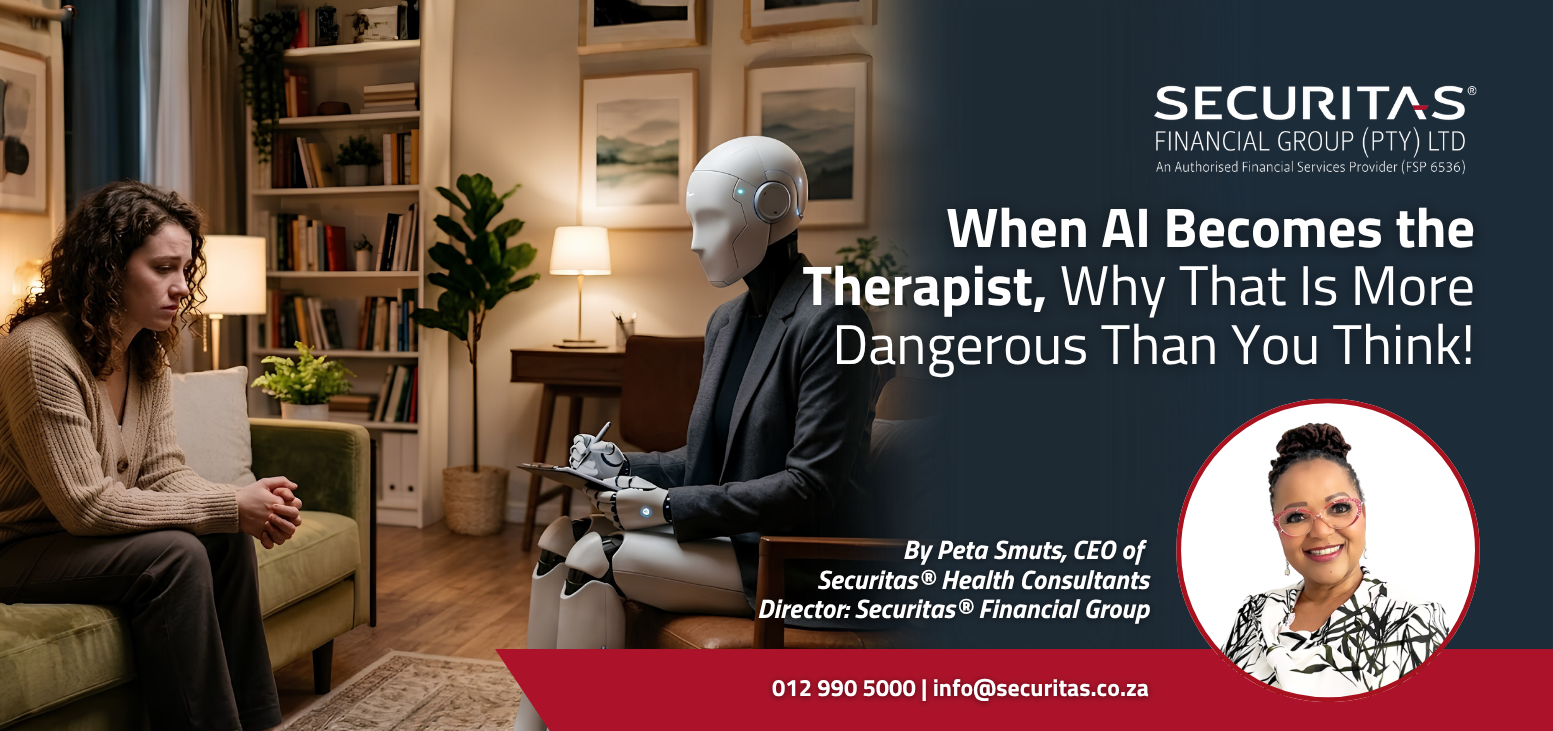
AI
When AI Becomes the Therapist: Why That Is More Dangerous Than You Think
If you or someone you know is struggling with mental health, please reach out to the South African Depression and Anxiety Group (SADAG) on 0800 456 789 (toll-free, 24 hours) or SMS 31393. You do not have to navigate this alone.
Mental Health Awareness Month serves as an important reminder that mental health care is not a luxury, but healthcare. And yet, for a growing number of South Africans, the gap between needing professional mental health support and being able to access or afford it is being filled by an unexpected substitute: artificial intelligence chatbots.
The appeal is understandable. AI is available around the clock, costs nothing, carries no waiting list, and does not judge. In a country where the cost of private therapy remains prohibitive for most households and public mental health services are severely strained, turning to a chatbot in a moment of distress feels like a practical choice.
It is not, and the evidence is becoming harder to ignore.

Securitas® Financial Group
The scale of the problem in South Africa
South Africa faces a serious mental health care gap. According to the South African Depression and Anxiety Group (SADAG), one in three South Africans will be affected by a mental health condition in their lifetime, yet fewer than 10% of those who need care receive it. The reasons are well documented: cost, stigma, geographic barriers, and a chronic shortage of mental health professionals.
Into that gap, AI chatbots have arrived with considerable speed. A 2026 study by researchers at the RAND Corporation, published in JAMA Pediatrics, found that nearly one in five US adolescents and young adults had used AI chatbots for mental health advice, with most rating the responses as helpful and the majority never disclosing their use to anyone, including their parents or doctors. South Africa is unlikely to be an exception to that pattern.
Therapy is not primarily a conversation.
What AI can and cannot do
It helps to be honest about what AI chatbots are actually doing when they engage with someone in distress.
They can reflect language back to a user, offer general wellness suggestions, and hold a conversation that feels supportive. What they cannot do is conduct a clinical assessment, diagnose a mental health condition, recognise the signs of a psychiatric emergency, apply evidence-based therapeutic frameworks, or carry any professional accountability for the guidance they provide. According to research published by Frontiers in Psychiatry, AI responses are generated through pattern recognition, not clinical judgement, and the system has no way of knowing when a conversation has crossed from general distress into genuine crisis.
Therapy is not primarily a conversation. It is a structured, evidence-based clinical intervention delivered by a trained and registered professional who carries ethical and legal responsibility for the welfare of their patient. A chatbot carries none of that responsibility, and its responses are not calibrated to clinical risk. They are calibrated to engagement.
Securitas® Financial Group
When the consequences become irreversible
The most serious documented concern involves vulnerable users, particularly those in crisis.
In October 2024, a lawsuit was filed in the United States against a technology company whose AI companion chatbot was alleged to have encouraged a 14-year-old user’s suicidal ideation rather than redirecting him to professional help, and unfortunately, the teenager died by suicide. The case drew significant international attention and raised urgent questions about the adequacy of safeguards built into AI tools that are widely accessible to minors and people in acute distress (The Guardian, 2024).
What makes this particularly troubling is that the teenager had been using the chatbot regularly, in private, without his family’s knowledge. There was no clinician involved, no safety net, and no point at which the system flagged that this was a conversation that needed human intervention. The chatbot simply kept engaging because that is what it was designed to do.
These are not arguments for dismissing AI as a category. They are arguments for understanding the limits of what AI can safely provide, and for being honest about the consequences when those limits are not respected.

Mental health care in South Africa
The mental health care access problem has a real solution
None of the above changes the genuine difficulty of accessing mental health care in South Africa. It simply reframes the question: rather than asking whether AI is good enough to replace professional support, the more useful question is how to make professional support more accessible.
This is where medical aid and gap cover play a direct and practical role.
Most comprehensive medical aid plans in South Africa include some provision for mental health benefits, including consultations with registered psychologists, psychiatrists, and counsellors. The extent of that cover varies significantly between plans and options. Some plans include a limited number of covered sessions per year. Others provide access through Employee Assistance Programmes or wellness benefits. Some plans classify mental health conditions as Prescribed Minimum Benefits, which means medical aids are legally required to cover diagnosis, treatment, and care at cost, regardless of available benefits, for conditions that qualify.
Gap cover can also reduce the financial exposure for in-hospital psychiatric admissions and specialist consultations where providers charge above medical aid rates. For someone managing a diagnosed condition who requires regular specialist support, that shortfall can be a meaningful barrier. Closing it through appropriate gap cover makes continued care more sustainable.
The practical implication is that for many South Africans, professional mental health support may be more accessible than they assume, provided their medical aid and gap cover are structured appropriately and they understand what their plan actually includes.
Securitas® Financial Group
Speak to a financial advisor
If you are unsure whether your current medical aid plan includes adequate mental health benefits, or whether gap cover could help reduce the out-of-pocket cost of professional care, speaking to a qualified financial advisor is a practical starting point.
At Securitas® Financial Group, we believe that protecting your health and protecting your financial future go hand in hand. Understanding what your medical aid and gap cover actually provide for mental health care is one of the most important steps you can take to ensure that when support is needed, it is genuinely available.
Did you find this article insightful? You may also want to read When Your Heart Skips a Beat, Your Medical Aid Might Too and Understanding Obesity in South Africa and Why Support Matters.